Showing posts with label Animal Images. Show all posts

Tuesday, 28 February 2017

Pond Skater (Gerridae) Images Collection

Pond Skater (Gerridae) Images Collection
Pond Skater images - The Gerridae are a family of insects in the order Hemiptera, commonly known as water striders, water bugs, pond skaters, water skippers, or jesus bugs. Consistent with the classification of the Gerridae as true bugs (i.e., suborder Heteroptera), gerrids have mouthparts evolved for piercing and sucking, and distinguish themselves by having the unique ability to walk on water. Gerridae, or water striders, are anatomically built to transfer their weight to be able to run on top of the water's surface. As a result, one could likely find water striders present in any pond, river, or lake. Scientists have identified over 1,700 species of gerrids, 10% of them being marine. (Wikipedia)
Images Source:
Wikipedia.Org, Pixabay.Com

Pond Skater Images

By Markus Gayda, CC BY-SA 3.0, https://commons.wikimedia.org/w/index.php?curid=198901

By Bruce J. Marlin - Own Work http://www.cirrusimage.com/bugs_water_strider.htm, CC BY-SA 2.5, https://commons.wikimedia.org/w/index.php?curid=2131043

By Webrunner - Own work, CC BY-SA 3.0, https://commons.wikimedia.org/w/index.php?curid=10424206

By Cory, CC BY-SA 2.1 jp, https://commons.wikimedia.org/w/index.php?curid=1242390

By Fritz Geller-Grimm - Own work, CC BY 2.5, https://commons.wikimedia.org/w/index.php?curid=1049734


Images of Pond Skater

While 90% of the Gerridae are freshwater bugs, the oceanic Halobates makes the family quite exceptional among insects. The genus Halobates was first heavily studied between 1822 and 1883 when Buchanan-White collected several different species during the Challenger Expedition. Around this time, Eschscholtz discovered three species of the Gerridae, bringing attention to the species, though little of their biology was known. Since then, the Gerridae have been continuously studied due to their ability to walk on water and unique social characteristics. Small gerrids have frequently been confused with the other semiaquatic bugs, the Veliidae. The most consistent characteristic used to separate these two families are internal genitalia differences. Since internal genitalia require specific training and tools to identify, it is almost impossible to tell a member of the Gerridae apart from a member of the Veliidae by external visual cues. One must study their habitat and behaviors to properly differentiate the two without looking at their specific anatomy.

attention: all images contained on this "Pond Skater Images" page does not belong to this blog, the images used for information purposes only. If you are the owner of the image above and don't want the picture shown, please contact us and we'll remove it immediately. Thank you

Platypus Images Collection

Platypus Images Collection
Platypus images - The platypus (Ornithorhynchus anatinus), sometimes referred to as the duck-billed platypus, is a semiaquatic egg-laying mammal endemic to eastern Australia, including Tasmania. Together with the four species of echidna, it is one of the five extant species of monotremes, the only mammals that lay eggs instead of giving birth. The animal is the sole living representative of its family (Ornithorhynchidae) and genus (Ornithorhynchus), though a number of related species have been found in the fossil record. The first preserved platypus body was thought to have been a fake, made of several animals sewn together, when it was first looked at by scientists in 1799. (Wikipedia)
Images Source:
Wikipedia.Org, Pixabay.Com

Platypus Images

By Stefan Kraft - Selbst fotografiert am 20.9.2004 im Sydney Aquarium., CC BY-SA 3.0, https://commons.wikimedia.org/w/index.php?curid=657498

By Klaus - Flickr: Wild Platypus 4, CC BY-SA 2.0, https://commons.wikimedia.org/w/index.php?curid=32551315

By Peter Scheunis - Own work, CC BY 1.0, https://commons.wikimedia.org/w/index.php?curid=103809

By TwoWings - Own work (NB : this is a scanned photography since it had been taken with an analog camera), CC BY-SA 3.0, https://commons.wikimedia.org/w/index.php?curid=3532075

By PanBK at the English language Wikipedia, CC BY-SA 3.0, https://commons.wikimedia.org/w/index.php?curid=6432906


Images of Platypus

The unusual appearance of this egg-laying, duck-billed, beaver-tailed, otter-footed mammal baffled European naturalists when they first encountered it, with some considering it an elaborate hoax. It is one of the few species of venomous mammals: the male platypus having a spur on the hind foot that delivers a venom capable of causing severe pain to humans. The unique features of the platypus make it an important subject in the study of evolutionary biology and a recognisable and iconic symbol of Australia; it has appeared as a mascot at national events and is featured on the reverse of its 20-cent coin. The platypus is the animal emblem of the state of New South Wales.
Until the early 20th century, it was hunted for its fur, but it is now protected throughout its range. Although captive breeding programs have had only limited success and the platypus is vulnerable to the effects of pollution, it is not under any immediate threat.

attention: all images contained on this "Platypus Images" page does not belong to this blog, the images used for information purposes only. If you are the owner of the image above and don't want the picture shown, please contact us and we'll remove it immediately. Thank you

Piranha Images Collection

Piranha Images Collection
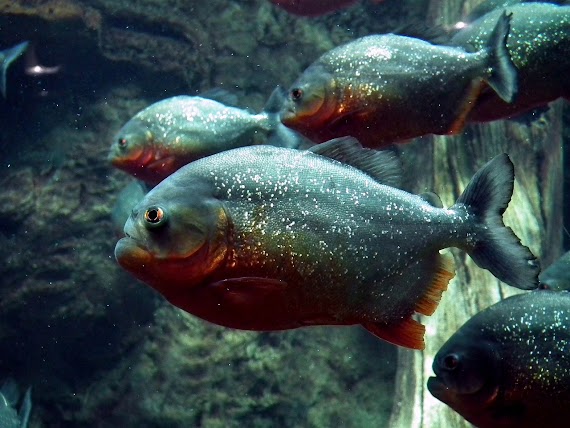
Piranha images - A piranha or piraña (/pᵻˈrɑːnjə/, /pᵻˈrænjə/, or /pᵻˈrɑːnə/; Portuguese: [piˈɾɐ̃ɲɐ], Spanish: [piˈɾaɲa]) is a member of family Characidae in order Characiformes, an omnivorous freshwater fish that inhabits South American rivers. In Venezuela, they are called caribes. They are known for their sharp teeth and powerful jaws. (Wikipedia)
Images Source:
Wikipedia.Org, Pixabay.Com

Piranha Images


Images of Piranha

Size

Piranhas are normally about 14 to 26 cm (5.5 to 10.2 in) long, although some specimens have been reported to be up to 43 cm (17 in) in length.

Morphology

Serrasalmus, Pristobrycon, Pygocentrus, and Pygopristis are most easily recognized by their unique dentition. All piranhas have a single row of sharp teeth in both jaws; the teeth are tightly packed and interlocking (via small cusps) and are used for rapid puncture and shearing. Individual teeth are typically broadly triangular, pointed, and blade-like (flat in profile). The variation in the number of cusps is minor; in most species, the teeth are tricuspid with a larger middle cusp which makes the individual teeth appear markedly triangular. The exception is Pygopristis, which has pentacuspid teeth and a middle cusp usually only slightly larger than the other cusps.

Biting Abilities

Piranhas have one of the strongest bites found in bony fishes. Relative to body mass, the black piranha (Serrasalmus rhombeus) produces one of the most forceful bites measured in vertebrates. This extremely powerful bite is generated by large jaw muscles (adductor mandibulae) that are attached closely to the tip of the jaw, conferring the piranha with a mechanical advantage that favors force production over bite speed. Strong jaws combined with finely serrated teeth make them adept at tearing flesh.

attention: all images contained on this "Piranha Images" page does not belong to this blog, the images used for information purposes only. If you are the owner of the image above and don't want the picture shown, please contact us and we'll remove it immediately. Thank you

Monday, 27 February 2017

Pika Images Collection

Pika Images Collection
Pika images - A pika (/ˈpaɪkə/ PY-kə; archaically spelled pica) is a small mammal, with short limbs, very round body, rounded ears, and no external tail. Pikas look like a combination of a rabbit, guinea pig or vole. They live in mountainous countries in Asia, with two species also in North America. Most pikas prefer rocky slopes. The large-eared pika of the Himalayas and nearby mountains is one of the highest living mammals, found at heights of more than 6000 m. Pikas graze on a range of plants, mostly grasses, flowers and young stems. In the autumn, they pull hay, soft twigs and other stores of food into their burrows to eat during the long, cold winter. The name "pika" is used for any member of the Ochotonidae, a family within the order of lagomorphs, which also includes the Leporidae (rabbits and hares). One genus, Ochotona, is recognised within the family, and it includes 30 species. It is also known as the "whistling hare" due to its high-pitched alarm call when diving into its burrow. In the United States, the pika is colloquially called a "coney", a nonspecific term also used for rabbits, hares, and hyraxes. The name "pika" appears to be derived from the Tungus piika and the scientific name Ochotona is from the Mongolian word ogdoi which means pika. (Wikipedia)
Images Source:
Wikipedia.Org, Pixabay.Com

Pika Images


By The poison of doubt - Own work, CC BY-SA 3.0, https://commons.wikimedia.org/w/index.php?curid=19584158


Images of Pika

Pikas are small mammals, with short limbs and rounded ears. They are about 15 to 23 centimetres (5.9 to 9.1 in) in body length and weigh between 120 and 350 grams (4.2 and 12.3 oz), depending on species. Like rabbits, after eating they initially produce soft green feces, which they eat again to take in further nutrition, before producing the final, solid, fecal pellets. Some pikas, such as the collared pika, have been known to store dead birds in their burrows, for food during winter.

attention: all images contained on this "Pika Images" page does not belong to this blog, the images used for information purposes only. If you are the owner of the image above and don't want the picture shown, please contact us and we'll remove it immediately. Thank you

Pig Images With Names

Pig Images With Names
Pig images - A pig is any of the animals in the genus Sus, within the Suidae family of even-toed ungulates. Pigs include the domestic pig and its ancestor, the common Eurasian wild boar (Sus scrofa), along with other species; related creatures outside the genus include the peccary, the babirusa, and the warthog. Pigs, like all suids, are native to the Eurasian and African continents. Juvenile pigs are known as piglets. Pigs are highly social and intelligent animals. With around 1 billion individuals alive at any time, the domesticated pig is one of the most numerous large mammals on the planet. Pigs are omnivores and can consume a wide range of food, similar to humans. Pigs can harbour a range of parasites and diseases that can be transmitted to humans. Because of the similarities between pigs and humans, pigs are used for human medical research. (Wikipedia)
Images Source:
Wikipedia.Org, Pixabay.Com

Pig Images

Wild boar

 
By Valentin Panzirsch - File:Wildschein, Nähe Pulverstampftor.jpg, CC BY-SA 3.0 at, https://commons.wikimedia.org/w/index.php?curid=46902117

Domestic pig

 
By Scott Bauer, USDA - http://www.ars.usda.gov/is/graphics/photos/jun01/k9441-1.htm, Public Domain, https://commons.wikimedia.org/w/index.php?curid=84375

Peccary (domestication)

 
By Taken byfir0002 | flagstaffotos.com.auCanon 20D + Canon 70-200mm f/2.8 L - Own work, GFDL 1.2, https://commons.wikimedia.org/w/index.php?curid=1388968

Truffle hog

By Vayssie Robert Robert Vayssié - Own workGignac Lot France, CC BY-SA 3.0, https://commons.wikimedia.org/w/index.php?curid=14767965

Pot-bellied pig

By Alvesgaspar - Own work (own photo), GFDL, https://commons.wikimedia.org/w/index.php?curid=4565880

Babirusa

By Masteraah at German Wikipedia - Own work, CC BY-SA 2.0 de, https://commons.wikimedia.org/w/index.php?curid=4243310

Red river hog

By Jean-Pol GRANDMONT - Self-photographed, CC BY 3.0, https://commons.wikimedia.org/w/index.php?curid=25601361

Bushpig

By en:User:Cburnett - Own work, CC BY-SA 3.0, https://commons.wikimedia.org/w/index.php?curid=2290723

Pig Beach

By cdorobek - Flickr: 08.2012 Vorobek Bahamas - swimming pigs, CC BY 2.0, https://commons.wikimedia.org/w/index.php?curid=25140064

Images of Pig

Pigs are omnivores, which means that they consume both plants and animals. In the wild, they are foraging animals, primarily eating leaves, grasses, roots, fruits, and flowers. In confinement, pigs are fed mostly corn and soybean meal with a mixture of vitamins and minerals added to the diet. Traditionally they were raised on dairy farms and called "mortgage lifters" due to their ability to use the excess milk as well as whey from cheese and butter making combined with pasture. Older pigs will consume three to five gallons of water per day.

attention: all images contained on this "Pig Images" page does not belong to this blog, the images used for information purposes only. If you are the owner of the image above and don't want the picture shown, please contact us and we'll remove it immediately. Thank you

Friday, 24 February 2017

Oyster Images Collection

Oyster Images Collection
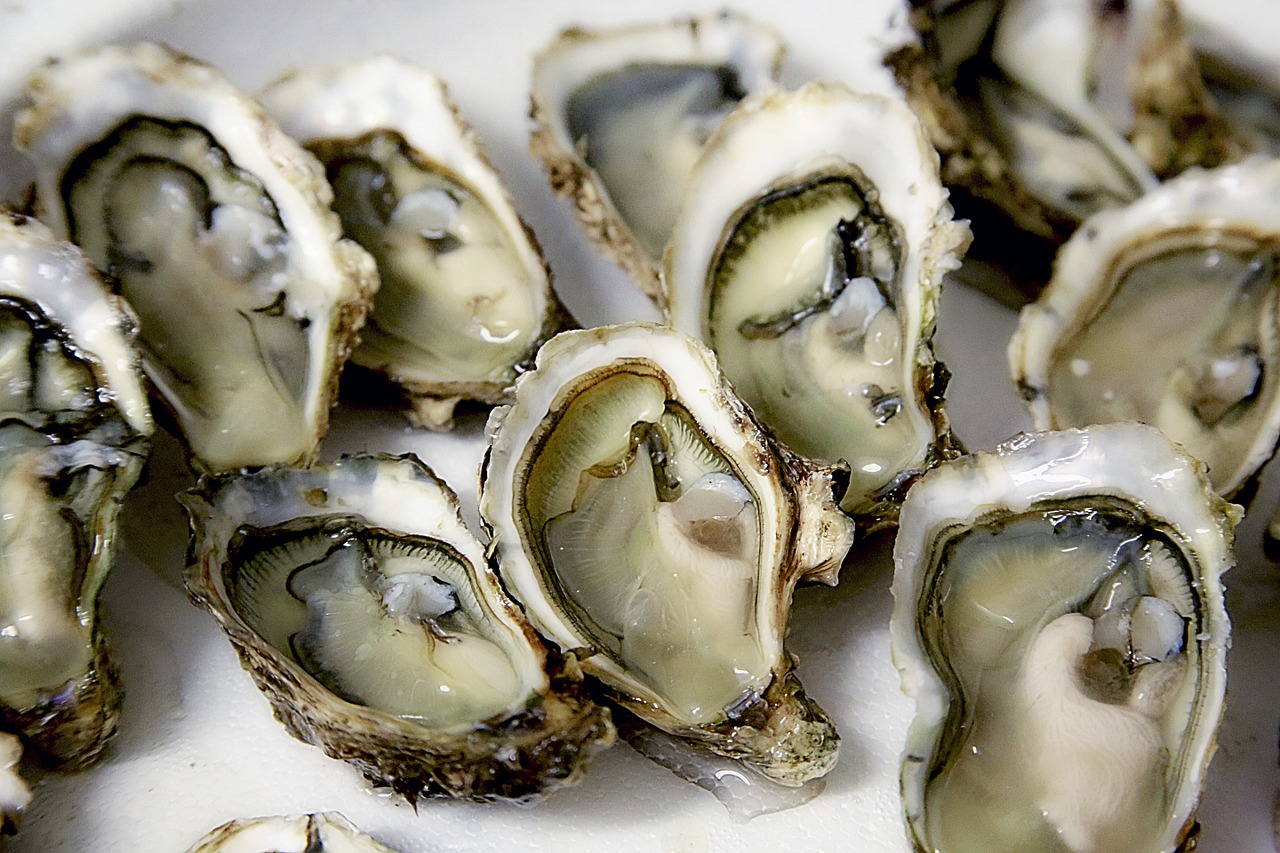
Oyster images - Oyster is the common name for a number of different families of salt-water bivalve molluscs that live in marine or brackish habitats. In some species the valves are highly calcified, and many are somewhat irregular in shape. Many, but not all, oysters are in the superfamily Ostreoidea.
Some kinds of oysters are commonly consumed by humans, cooked or raw, the latter being a delicacy. Some kinds of pearl oysters are harvested for the pearl produced within the mantle. Windowpane oysters are harvested for their translucent shells, which are used to make various kinds of decorative objects. (Wikipedia)

Images Source:
Wikipedia.Org, Pixabay.Com

Oyster Images


Images of Oyster

Oysters are filter feeders, drawing water in over their gills through the beating of cilia. Suspended plankton and particles are trapped in the mucus of a gill, and from there are transported to the mouth, where they are eaten, digested, and expelled as feces or pseudofeces. Oysters feed most actively at temperatures above 10 °C (50 °F). An oyster can filter up to 5 L (1.3 US gal) of water per hour. The Chesapeake Bay's once-flourishing oyster population historically filtered excess nutrients from the estuary's entire water volume every three to four days. Today, that would take nearly a year. Excess sediment, nutrients, and algae can result in the eutrophication of a body of water. Oyster filtration can mitigate these pollutants.
In addition to their gills, oysters can also exchange gases across their mantles, which are lined with many small, thin-walled blood vessels. A small, three-chambered heart, lying under the adductor muscle, pumps colorless blood to all parts of the body. At the same time, two kidneys, located on the underside of the muscle, remove waste products from the blood. Their nervous system includes two pairs of nerve cords and three pairs of ganglia.
While some oysters have two sexes (European oyster and Olympia oyster), their reproductive organs contain both eggs and sperm. Because of this, it is technically possible for an oyster to fertilize its own eggs. The gonads surround the digestive organs, and are made up of sex cells, branching tubules, and connective tissue.
Once the female is fertilized, she discharges millions of eggs into the water. The larvae develop in about six hours and exist suspended in the water column as veliger larvae for two to three weeks before settling on a bed and maturing to sexual adulthood within a year.

attention: all images contained on this "Oyster Images" page does not belong to this blog, the images used for information purposes only. If you are the owner of the image above and don't want the picture shown, please contact us and we'll remove it immediately. Thank you

Otter Images Cute

Otter Images Cute
Otter images - Otters are carnivorous mammals in the subfamily Lutrinae. The 13 extant otter species are all semiaquatic, aquatic or marine, with diets based on fish and invertebrates. Lutrinae is a branch of the weasel family Mustelidae, which also includes badgers, honey badgers, martens, minks, polecats, and wolverines. (Wikipedia)
Images Source:
Wikipedia.Org, Pixabay.Com

Otter Images


Images of Otter

Otters have long, slim bodies and relatively short limbs. Their most striking anatomical features are the powerful webbed feet used to swim, and their seal-like abilities holding breath underwater. Most have sharp claws on their feet and all except the sea otter have long, muscular tails. The 13 species range in adult size from 0.6 to 1.8 m (2.0 to 5.9 ft) in length and 1 to 45 kg (2.2 to 99.2 lb) in weight. The Oriental small-clawed otter is the smallest otter species and the giant otter and sea otter are the largest. They have very soft, insulated underfur, which is protected by an outer layer of long guard hairs. This traps a layer of air which keeps them dry, warm, and somewhat buoyant under water.
Several otter species live in cold waters and have high metabolic rates to help keep them warm. European otters must eat 15% of their body weight each day, and sea otters 20 to 25%, depending on the temperature. In water as warm as 10 °C (50 °F), an otter needs to catch 100 g (3.5 oz) of fish per hour to survive. Most species hunt for three to five hours each day and nursing mothers up to eight hours each day.
For most otters, fish is the staple of their diet. This is often supplemented by frogs, crayfish and crabs. Some otters are expert at opening shellfish, and others will feed on available small mammals or birds. Prey-dependence leaves otters very vulnerable to prey depletion. Sea otters are hunters of clams, sea urchins and other shelled creatures. They are notable for their ability to use stones to break open shellfish on their stomachs. This skill must be learned by the young.
Otters are active hunters, chasing prey in the water or searching the beds of rivers, lakes or the seas. Most species live beside water, but river otters usually enter it only to hunt or travel, otherwise spending much of their time on land to avoid their fur becoming waterlogged. Sea otters are considerably more aquatic and live in the ocean for most of their lives.
Otters are playful animals and appear to engage in various behaviors for sheer enjoyment, such as making waterslides and then sliding on them into the water. They may also find and play with small stones. Different species vary in their social structure, with some being largely solitary, while others live in groups – in a few species these groups may be fairly large.

attention: all images contained on this "Otter Images" page does not belong to this blog, the images used for information purposes only. If you are the owner of the image above and don't want the picture shown, please contact us and we'll remove it immediately. Thank you

Thursday, 23 February 2017

White Rhinoceros Images Collection

White Rhinoceros Images Collection
White Rhinoceros images - The white rhinoceros or square-lipped rhinoceros (Ceratotherium simum) is the largest extant species of rhinoceros. It has a wide mouth used for grazing and is the most social of all rhino species. The white rhinoceros consists of two subspecies: the southern white rhinoceros, with an estimated 19,682–21,077 wild-living animals in the year 2015, and the much rarer northern white rhinoceros. The northern subspecies had very few remaining, with only three confirmed individuals left in 2015 (two females Fatu, 15 and Najin, 25 and one male Sudan, 42), all in captivity. (Wikipedia)

Images Source:
Wikipedia.Org, Pixabay.Com

White Rhinoceros Images


Images of White Rhinoceros

The white rhinoceros is the largest of the five species of rhinoceros. It weighs slightly more on average than a hippopotamus despite a considerable mass overlap between these two species. It has a massive body and large head, a short neck and broad chest. The head and body length is 3.7 to 4 m (12.1 to 13.1 ft) in males and 3.4 to 3.65 m (11.2 to 12.0 ft) in females, with the tail adding another 70 cm (28 in) and the shoulder height is 170 to 186 cm (5.58 to 6.10 ft) in the male and 160 to 177 cm (5.25 to 5.81 ft) in the female. The male, averaging about 2,300 kg (5,100 lb) is heavier than the female, at an average of about 1,700 kg (3,700 lb). The largest size the species can attain is not definitively known, specimens of up to 3,600 kg (7,900 lb) are considered reliable, while larger sizes have been claimed but are not verified. On its snout it has two horn-like growths, one behind the other. These are made of solid keratin, in which they differ from the horns of bovids (cattle and their relatives), which are keratin with a bony core, and deer antlers, which are solid bone. The front horn is larger and averages 60 cm (24 in) in length, reaching as much as 150 cm (59 in) but only in females. The white rhinoceros also has a noticeable hump on the back of its neck. Each of the four stumpy feet has three toes. The color of the body ranges from yellowish brown to slate grey. Its only hair is the ear fringes and tail bristles. White rhinos have a distinctive broad, straight mouth which is used for grazing. Its ears can move independently to pick up sounds but it depends most of all on smell. The olfactory passages which are responsible for smell are larger than their entire brain. The white rhinoceros has the widest set nostrils of any land based animal.

attention: all images contained on this "White Rhinoceros Images" page does not belong to this blog, the images used for information purposes only. If you are the owner of the image above and don't want the picture shown, please contact us and we'll remove it immediately. Thank you

Wild Boar Images Collection

Wild Boar Images Collection
Wild Boar images - The wild boar (Sus scrofa), also known as the wild swine or Eurasian wild pig, is a suid native to much of Eurasia, North Africa, and the Greater Sunda Islands. Human intervention has spread its range further, making the species one of the widest-ranging mammals in the world, as well as the most widely spread suiform. Its wide range, high numbers, and adaptability mean that it is classed as least concern by the IUCN. The animal probably originated in Southeast Asia during the Early Pleistocene, and outcompeted other suid species as it spread throughout the Old World. (Wikipedia)

Images Source:
Wikipedia.Org, Pixabay.Com

Wild Boar Images


Images of Wild Boar

Subspecies
As of 2005, 16 subspecies are recognised, which are divided into four regional groupings:


  • Western: Includes S. s. scrofa, S. s. meridionalis, S. s. algira, S. s. attila, S. s. lybicus, and S. s. nigripes. These subspecies are typically high-skulled (though lybicus and some scrofa are low-skulled), with thick underwool and (excepting scrofa and attila) poorly developed manes.
  • Indian: Includes S. s. davidi and S. s. cristatus. These subspecies have sparse or absent underwool, with long manes and prominent bands on the snout and mouth. While S. s. cristatus is high-skulled, S. s. davidi is low-skulled.
  • Eastern: Includes S. s. sibiricus, S. s. ussuricus, S. s. leucomystax, S. s. riukiuanus, S. s. taivanus, and S. s. moupinensis. These subspecies are characterised by a whitish streak extending from the corners of the mouth to the lower jaw. With the exception of S. s. ussuricus, most are high-skulled. The underwool is thick, except in S. s. moupinensis, and the mane is largely absent.
  • Indonesian: Represented solely by S. s. vittatus, it is characterised by its sparse body hair, lack of underwool, fairly long mane, a broad reddish band extending from the muzzle to the sides of the neck. It is the most basal of the four groups, having the smallest relative brain size, more primitive dentition and unspecialised cranial structure.


attention: all images contained on this "Wild Boar Images" page does not belong to this blog, the images used for information purposes only. If you are the owner of the image above and don't want the picture shown, please contact us and we'll remove it immediately. Thank you