Showing posts with label Frog Images. Show all posts

Wednesday, 1 March 2017

Pool Frog Images Collection

Pool Frog Images Collection
Pool Frog images - The pool frog (Pelophylax lessonae) is a European frog. It is one of only four amphibian species recognized by the UK government as protected under its Biodiversity Action Plan. The reasons for declining populations are decreased pond habitat from human encroachment and also air pollution leading to over-nitrification of pond waters. Its specific name was chosen by the Italian herpetologist Lorenzo Camerano in order to honour his master Michele Lessona. (Wikipedia)
Images Source:
Wikipedia.Org, Pixabay.Com

Pool Frog Images

By Piet Spaans - Own work, CC BY-SA 2.5, https://commons.wikimedia.org/w/index.php?curid=1683096


CC BY-SA 3.0, https://commons.wikimedia.org/w/index.php?curid=14101


Images of Pool Frog

The pool frog has not always been recognised as a native British species. Part of the reason for this is that other similar species are known to have been introduced. However research has now shown that a native origin is most likely.
The Herpetological Conservation Trust website states that "The Pool Frog is a European frog and was formerly recorded from two sites in East Anglia although it was lost from one of these in the middle of the 19th century. It was presumed extinct in the wild at the last remaining site by 1995. A single individual known from this population survived in captivity until 1999. Other populations have become established in the UK and it is known that some of these included individuals of British origin in their founding stock."
An English Nature reintroduction project is underway in Breckland, where pool frogs were introduced to a single site in 2005.

attention: all images contained on this "Pool Frog Images" page does not belong to this blog, the images used for information purposes only. If you are the owner of the image above and don't want the picture shown, please contact us and we'll remove it immediately. Thank you

Tuesday, 28 February 2017

Poison Dart Frog Images Collection

Poison Dart Frog Images Collection
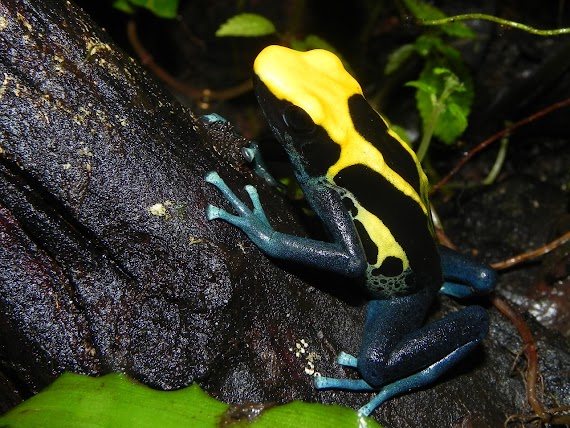
Poison Dart Frog images - Poison dart frog (also known as dart-poison frog, poison frog or formerly known as poison arrow frog) is the common name of a group of frogs in the family Dendrobatidae which are native to tropical Central and South America. These species are diurnal and often have brightly colored bodies. This bright coloration is correlated with the toxicity of the species, making them aposematic. Some species of the Dendrobatidae family exhibit extremely bright coloration along with high toxicity, while others have cryptic coloration with minimal to no amount of observed toxicity. The species that have great toxicity, derive this from their diet of ants, mites and termites. Other species however, that exhibit cryptic coloration and low to no amounts of toxicity, eat a much larger variety of prey. Many species of this family are threatened due to human infrastructure encroaching the places they inhabit. (Wikipedia)
Images Source:
Wikipedia.Org, Pixabay.Com

Poison Dart Frog Images


Images of Poison Dart Frog

Most species of poison dart frogs are small, sometimes less than 1.5 cm (0.59 in) in adult length, although a few grow up to 6 cm (2.4 in) in length. They weigh 1 oz. on average. Most poison dart frogs are brightly colored, displaying aposematic patterns to warn potential predators. Their bright coloration is associated with their toxicity and levels of alkaloids. For example, frogs of the genus Dendrobates have high levels of alkaloids, whereas Colostethus species are cryptically colored and are not toxic.
Poison dart frogs are an example of an aposematic organism. Their bright coloration advertises unpalatability to potential predators. Aposematism is currently thought to have originated at least four times within the poison dart family according to phylogenetic trees, and dendrobatid frogs have since undergone dramatic divergences – both interspecific and intraspecific – in their aposematic coloration. This is surprising given the frequency-dependent nature of this type of defense mechanism.

attention: all images contained on this "Poison Dart Frog Images" page does not belong to this blog, the images used for information purposes only. If you are the owner of the image above and don't want the picture shown, please contact us and we'll remove it immediately. Thank you